
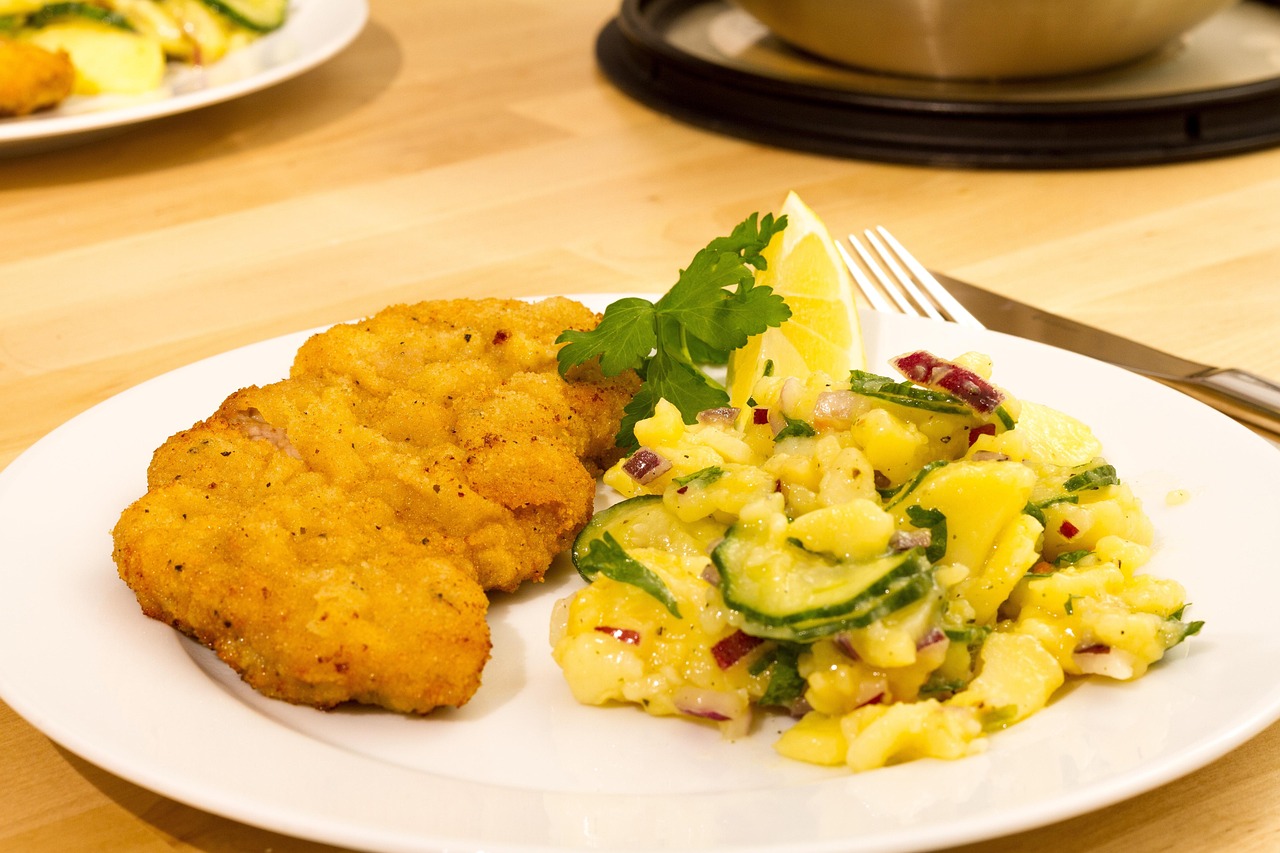
There’s just something utterly joyful about a golden, crispy schnitzel—it’s a bit of Austria’s soul on a plate, and it happens to be absurdly comforting. Back in Vienna, few things beat the classic Wiener Schnitzel, pounded thin, lovingly breaded, and crisp-fried until it’s whisper-light and lacy. Paired with Erdäpfelsalat—the Austrian-style potato salad with a delicate vinegar-based dressing—it’s about as Viennese as you can get.
My husband, however, wasn’t convinced at first. Years ago, on a trip to Vienna, I recommended the chain restaurant Wienerwald and told him to order the schnitzel. Unfortunately, it turned out dry and heavy — and he is still going on about how bad it was to this day. Not exactly the culinary memory I had hoped to give him.

(Side note: Wienerwald is still operating in Austria today, but in a modernised format. Sadly, the schnitzel my husband had back then was anything but modern or memorable.)
I’ve since redeemed myself: at home, schnitzel is light, crisp, and golden — made with love and good ingredients. These days, he happily asks for it, and I’ve convinced him with my schnitzels every single time.
Wiener Schnitzel vs Schnitzel Wiener Art
In Austria, the name Wiener Schnitzel is legally protected — it may only be used for schnitzel made with veal. If it’s made with pork, turkey, or chicken, the menu will usually say Schnitzel Wiener Art (“Viennese-style schnitzel”). In the UK, veal escalopes aren’t a common everyday cut, though you can source British rosé veal from butchers or online farms if you’d like the classic.
At our table, we most often use turkey steaks — easy to find in Lidl and Morrisons — which fry up beautifully and have become our family favourite. Pork loin steaks and chicken fillets are also great alternatives and much easier to find. With the right technique, they all give you that golden, airy crust and tender centre that makes schnitzel so irresistible.
Ingredients
For the Schnitzel:
- 4 turkey steaks (or pork loin/veal, about 120–150 g each), pounded thin
- Salt & freshly ground black pepper
- 50 g plain flour
- 2 large eggs, beaten
- 100 g breadcrumbs
- Frying Fat (such as lard, Sunflower oil or similar)
- 1 lemon, cut into wedges
- Lingonberry Compot, Cranberry Compot or Ketchup on the side
For the Erdäpfelsalat (potato salad):
- 800 g waxy potatoes (Charlotte, Nicola, or Anya)
- 1 small onion, finely chopped
- 2 tbsp white wine vinegar
- 3 tbsp sunflower oil
- 1 tsp mustard (such as dijon)
- Salt & pepper
- Fresh chives, chopped
UK Sourcing tips
Turkey steaks and Pork loin steaks (without the bone) are usually readily available in most supermarkets.
Chicken fillets need to be sliced horizontally to create thinner cutlets before pounding.
Veal is less common but can be ordered from specialist butchers or online (look for British rosé veal).
Breadcrumbs: UK supermarkets usually offer two types — finer golden crumbs (for an even coating) and paler natural crumbs, which are closer to Austrian-style. Japanese panko is another good choice if you like an extra-light crust.
Choose waxy Potato varieties such as Charlotte, Nicola, or Anya, which hold their shape and absorb the dressing beautifully.
Prep: 25 minutes
Cook: 25 minutes
Serves: 4
Method:
- Prepare the potatoes: Boil the potatoes in their skins until just tender. Drain, peel while still warm, and slice thinly.
- Make the dressing: Combine the hot stock, vinegar, mustard, salt and pepper. Pour over the sliced potatoes and fold through gently. Add the chopped onion and oil, then leave to sit for at least 30 minutes to absorb the flavours. Scatter with chives before serving.
- Prepare the meat: Place each cutlet between two sheets of cling film or baking paper and gently pound until about 5 mm thin. A meat mallet works best, but a rolling pin or even the base of a heavy saucepan will do just as well. Take your time — the meat should spread evenly without tearing. Season lightly with salt and pepper.
- Prepare the schnitzel coating: Place flour, beaten eggs, and breadcrumbs in three shallow bowls. Season the flour. Dredge each escalope first in flour, then egg, then breadcrumbs. Do not press the crumbs on too firmly — the coating should stay loose and airy.
- Frying the schnitzel: Heat a generous amount of frying fat in a large pan. Traditionally, schnitzel was fried in lard, which gives a wonderful flavour and crisp crust. Clarified butter (Butterschmalz), sunflower oil, or rapeseed oil are also excellent choices. Whatever you use, make sure there’s enough for the schnitzel to “swim” — it shouldn’t just sit on the base of the pan. For extra flavour, add a little butter right before frying. Fry each schnitzel until golden brown, turning once, then drain briefly on paper towels.
- Serve: Place the schnitzel on warmed plates with the potato salad alongside. Add a lemon wedge on each schnitzel. In some places, a spoonful of lingonberry jam (Preiselbeeren) is offered on the side — sweet and tart, it cuts beautifully through the richness of the crust. Cranberry sauce makes a good substitute in the UK. And of course, some people still swear by ketchup. My husband dislikes all 3, but I swear by Lingonberry – usually something that falls in my basekt at IKEA.
While Erdäpfelsalat is the classic companion, Wiener Schnitzel is also often served with cucumber salad, a light green salad, or even parsley potatoes (Petersilienkartoffeln). In more rustic settings, chips have become popular too.
Leave a Reply